Tomorrow’s going to be my first (true) application lecture, at UFZ Leipzig. The slides are here:UFZ, Application Lecture 13.01.2012
It just occurred to me that I should probably further develop my research profile and find an appropriate umbrella term that best covers my research interests. A quick suggestion including a definition would be Environmental Data Mining to describe the task of finding interesting, novel and potentially useful knowledge (=data mining) in georeferenced (spatial) and temporal multi-layered data sets (=environmental data). I haven’t done any research on this umbrella term yet (search engines provided but a few hits, but if I stay in research, this is probably where I’d try to be headed. Computer science is (to me) an ancillary science that needs specific applications and builds/provides solutions to specific tasks based on actual data sets collected in practice. And R is the best tool for this :-)
(this merits a new category at the top level)
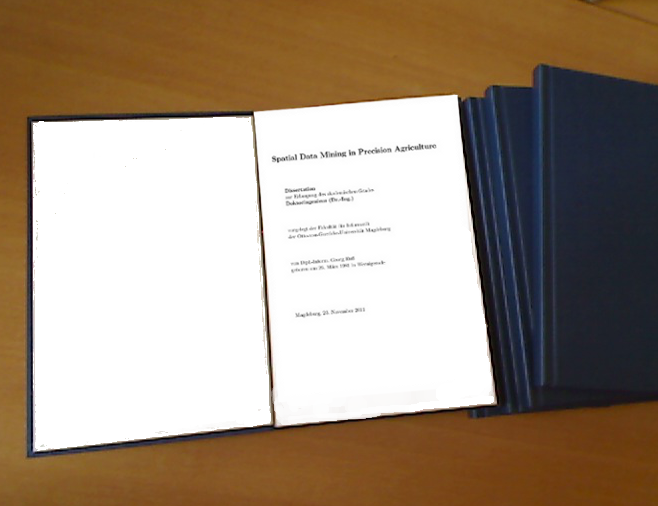
Mit dem offiziellen Datum vom 23.11.2011 habe ich heute meine Dissertation eingereicht. Jetzt ist der Fakultätsrat dran, dann sind es die Gutachter und wenn alles glatt läuft, bin ich bei der Verteidigung dran. Vorbehaltlich der Genehmigung durch den Fakultätsrat findet die Verteidigung am 23.02.2011, 15 Uhr, in 29-301 statt. Der Dissertationstitel entspricht der Überschrift dieses Blogs.
Fürs Binden habe ich übrigens 42 EUR bezahlt. Das kann doch kein Zufall sein!
There’s a preliminary deadline for handing in my thesis. I’m not sure whether I’m going to make it, but 2011-10-19 has been set as my personal deadline, before the thesis draft goes again to my supervisor. Lots of improvements yet to do. The official one is then 2011-11-23. The site’s header has been changed to reflect the actual topic of my PhD thesis.
Well, I updated the minihomer script described in this post. The issue was that the old script just output one GPX file describing the complete miniHomer’s log — currently around 23MB, comprising two continents. Although the GPX file is internally grouped into tracks, it’s quite cumbersome and slow to open with viking (which is not viking’s fault). Therefore, I added a few lines to use the gpxsplitter python script at the very end in the “dump” option. It simply takes the existing gpx file and outputs single files containing just one track, which is exactly what I wanted.
Here’s the script: minihomertool, version 2011-09-24
Just before I head off into the weekend, the latest update on where I’ll be next week:
Industrial Conference on Data Mining, taking place from Tuesday August 30th until Saturday, September 3rd, in New York City (actually, it’s near Newark Airport [EWR] in New Jersey, but it’s close enough). I’ll be presenting a continuation of my work on HACC-spatial (the hierarchical agglomerative spatially constrained clustering) which I showed at my workshop and the ICDM 2010 conference last year.
Therefore, my talks’ content will be along similar lines, with similar, but updated slides:
The second talk for my workshop will also contain a few slides about the joint paper with Antonio Mucherino, who won’t be able to come personally, but who contributed a nice survey for my 2nd Workshop on Data Mining in Agriculture.
I recently bought a Navin Minihomer for geocaching, geo-logging and wayfinding. Really nice device, and I got it to work under linux using gpsbabel using the following instructions:
The script below supports
The first command erases the log, the second can set the appropriate waypoint in the order they appear when cycling through the miniHomer’s menu (House to Bar) with lat/long in decimal degrees separated by spaces, the third reads the device’s log and splits it by day, and the fourth initializes the device to a certain speed (didn’t have to use it so far). The bash script requires setting the path to the gpsbabel (patched) binary and the USB device. It certainly works for me, except that gpsbabel produces strange gpx files where the dates of the points are set to sometime in the year 2031. I don’t care at the moment, it seems to be just a fixed shift. The last (dump) command just grabs the log dump from the logger, writes this to a file and processes it further, even correcting for the somewhat strange date by setting a negative offset of -172032 hours. Gpsbabel segfaults first, but still writes the log (but misses the waypoints in the dump, which I don’t need anyway).
Here’s the script: minihomertool bash script. It’s certainly not perfect, doesn’t care about errors and could clearly be more elegant, but whoever wants to can customize it.
There’s more information on the German znex site: http://www.znex.de/downloads.html.
In Kürze wird, nach langer Vorbereitungszeit, das Buch “Computational Intelligence” erscheinen, an dem ich als Koautor beteiligt bin. Insbesondere die buchbegleitenden Webseiten unter computational-intelligence.eu entstammen meiner Feder.
Last week I handed in the first 228-page draft of what’s probably going to be
my thesis. Let’s see what the reviewers say, I hope there are not too many
fundamental issues with that draft.
My thesis proceeds as expected and planned. The second main chapter is finished and off to the first reviewer, while the first main chapter is currently being written. The experiments are currently running on the lab machines (which are much quicker now than half a year ago using R — new hardware) and the plots will be generated soon. Time for applications. Deadlines seem to work :-)
The two latest papers of mine have been accepted at SCAI and ICDM. And there’s another upcoming journal article for (likely) GeoInformatica and the upcoming book of our working group on Computational Intelligence.
Those were the days …
Data Mining et al is powered by WordPress | Using Tiga theme with a bit of Ozh + WP 2.2 / 2.3 Tiga Upgrade