Georg Ruß' PhD Blog — R, clustering, regression, all on spatial data, hence it's:

Oktober 15th, 2008

Update: MLP vs. SVM vs. RBF

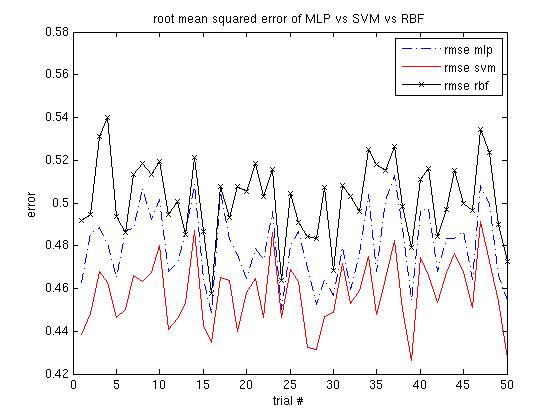
In the previous article on the MLP vs. SVM vs. RBF comparison the RBF performed worse than the other two. Well, even after doing some optimisation on the RBF parameters (hidden layer size), it is still continuously worse than SVM and MLP, although the margin is smaller.

Mean Absolute Error, MLP vs. SVM vs. RBFRoot Mean Squared Error, MLP vs. SVM vs. RBF

Oktober 15th, 2008

RBF parameters

Since the size of the hidden layer of the RBF network seems to be the most important parameter, I’ve run a short simulation that outputs a graph for the network’s performance (mae, rmse), plotted against the hidden layer’s size. As expected, the curve turns out flat with larger numbers of neurons. A good tradeoff seems to fix the size at 70 neurons (for the given data set, of course).
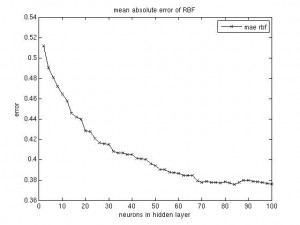
RBF parameters, MAERBF parameters, RMSE

(I could have plotted them into one figure, but I was too lazy to change the script.)

I’d like to mention that the cross validation partitioning step was done just once and the network’s parameter was varied just for this one data split. This might be a problem, but, as we saw in the previous post, the three models I’ve trained all perform similar, with similar ups and downs in performance over different data partitions. It therefore should be justified to run the RBF parameter experiment just on one split.

Oktober 15th, 2008

MLP vs. SVM vs. RBF

Yet another neural network, the radial basis function (RBF) network was used as a function approximation to compare against the MLP and SVM models. The parameter settings for the RBF have not been optimised so far. I simply ran it against the MLP/SVM on the same cross validation data. The results can be obtained from the following two graphics:

Mean Absolute Error, MLP vs. SVM vs. RBFRoot Mean Squared Error, MLP vs. SVM vs. RBF

The script for the above graphics is online.

At the moment I’m running some simulations to determine the size of the hidden layer of the RBF network, as this seems to be the most important parameter. The matlab implementation of the RBF network also takes some time to incrementally add neurons up to a maximum number (user-specified).

|